
Twice-Weekly Yoga Reduced Depression and Stress in Nursing Home Residents
A 10-week study showed significant gains in mood and heart rate variability — though researchers say group structure itself may deserve part of the credit.
By Yen Feng
Communications, Content, and Community Lead, Singapore Yoga Association
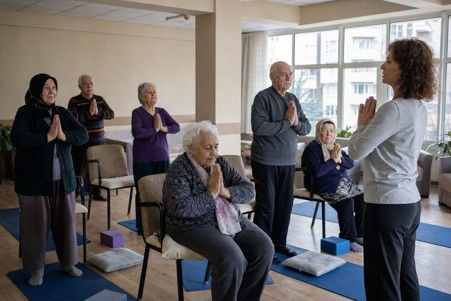
In a nursing home in Ankara, 18 residents spent two mornings a week on mats. They held mountain pose for three or four breaths, moved through cat, triangle, and a supported warrior, and ended in stillness.
Cushions, blocks, and chairs were on hand. Ten weeks later, they were doing better than when they started — and better than the 18 residents down the corridor who carried on as usual.
The study, published in Scientific Reports last month, tested something more specific than the usual yoga claims. It measured three things in people 65 and over living in institutional care: depression, satisfaction with leisure time, and heart rate variability (HRV) — a measure of how well the nervous system regulates itself.
These aren’t small concerns in a nursing home. Depression and withdrawal are common in later institutional life, often driven by loss, illness, and long stretches of unstructured time. The researchers framed yoga not as cardiovascular exercise but as recreational therapy — a structured activity offered to a group that usually has few.
Thirty-six residents completed the trial, split randomly into two groups. One did yoga for 45 to 60 minutes, twice a week, for 10 weeks: relaxation, gentle poses held for a few breaths, breathing practices, and meditation, with harder poses added later. The other group continued ordinary nursing home life. Both were tested for depression, leisure satisfaction, and HRV before and after.
Showing up is good enough
The results were clear. On the Geriatric Depression Scale, the yoga group’s average score fell from 5.67 to 2.38 — from the edge of mild depression to a range considered clear of it. Leisure satisfaction rose substantially. And across several HRV measures, the yoga group’s nervous systems shifted toward calm: less stress, more time spent settled rather than on alert.
The control group barely moved on the physical measures — and on depression, they got worse, rising from 5.72 to 6.78. Doing nothing didn’t mean staying the same.
Why yoga would produce these shifts is a reasonable guess: breathing and relaxation likely drive the HRV changes, and that calmer nervous system tracks with better mood, while the postures raise energy and ease discomfort. The HRV findings in particular were exploratory — many measures tested at once in a small sample, so some are probably noise.
But the real limit was the design of the study. There was no active control: no second group doing a different shared activity for the same 10 weeks. The study didn’t test yoga against walking, or a craft circle, or group conversation. It tested yoga against nothing.
That’s exactly why the control group’s slide into worse mood is the most telling number in the study.
Twice a week, the yoga group had somewhere to be, something to learn, a sequence to move through, and other people moving through it with them. In a population where isolation itself drives depression, 10 weeks of regular, companionable activity isn’t a neutral backdrop. It may be most of the treatment.
None of which is a reason to downplay the study’s results. The yoga group improved on measures that matter, through a practice that’s cheap, adaptable, and safe enough for people in their 80s, with chairs and cushions for support.
For an institution deciding how to fill residents’ time, that’s reason enough to run the class — and it fits older studies the authors cite, in which yoga programmes for the elderly lowered depression and raised life satisfaction over three and six months, with gains that held.
What the study can’t yet claim is that yoga is uniquely suited to aging bodies and minds, or that the poses do something a craft circle or a walking group couldn’t. What it shows is plenty on its own: 10 weeks of guided, twice-weekly group practice left a room of nursing home residents less depressed and more settled — while the ones left alone with their leisure time got worse.
For teachers who work with older adults, that may be the more useful framing anyway. The value isn’t a peak pose or a deep stretch. It’s the standing appointment, the familiar sequence, the breath slowed in company, the sense that the afternoon has a shape.
Whether that belongs to yoga specifically, or to structured activity more broadly, is a question the next study — with a fairer comparison — will answer.
Originally published by The Yoga Edit on 27 Jul 2026. Republished with permission.
About the Author
Yen Feng is the Communications, Content, and Community Lead of the Singapore Yoga Association (SYA) and the Founder & Editor of The Yoga Edit, a modern online publication exploring yoga as a living culture through thoughtful writing on the people, practices, and ideas shaping the yoga community today.
Read more of Yen's work at The Yoga Edit


Comments