
The Wrong Room For Yoga
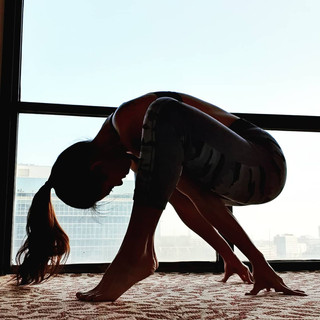
In a bare conference room at an addiction recovery centre, the absence of a modern yoga studio atmosphere made something else visible: the practice itself.
By Yen Feng
Communications, Content, and Community Lead, Singapore Yoga Association
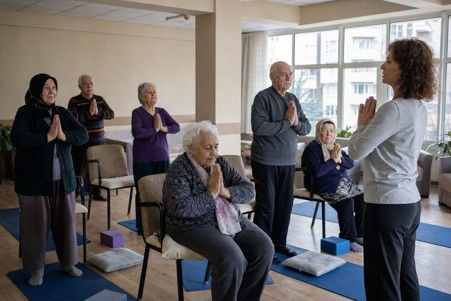
I taught a yoga class last Friday at an addiction recovery centre, in a conference room inside a community club.
The room was minimalist by default, not design. Thin polyester mats, meek, malnourished pillows, an armory of folded tables and chairs pushed against one wall, and a single wrinkled lamp standing in the corner. There were no mirrors, no candles, none of the things the spaces I usually teach in would consider the bare minimum.
By every measure of a modern yoga studio, this room was all wrong.
I have worked with people in recovery before, but always one at a time, never as a group, and I went in that afternoon not really knowing what I was walking into. If I’m being honest, I still don’t know much. I couldn’t tell you what got them there, what they were recovering from, or what they had done before they arrived. By the end of the 90 minutes, however, I had stopped trying to work it out, because it had stopped seeming like the point.
They were people on mats, and we were going to do some yoga.
I kept it simple. We began seated, taking long breaths to steady the body, a few quiet minutes to let the mind settle.
Then gentle work for the neck, then the spine, moving in every direction it knows — folding, extending, twisting. I explained we were doing Yin today, and what that meant, the long holds, the stillness that’s harder than it looks, and we moved into butterfly and a seated fold, resting back to the mat between each shape. Cat-cow. Child’s pose. Lizard, then pigeon. Then a long savasana, close to 10 minutes, and several of them fell asleep.
It was during savasana that I felt something stir inside me. The participants were still, some of them already asleep, and I felt the weight of something settle over the room — not their stories, which I didn’t know about, but something underneath the stories that didn’t need telling to be felt.
It took me back to the last morning of my Men’s Retreat last year.
I had gone to the studio earlier than usual, to meditate, and I couldn’t. I kept thinking about what it must have taken for each of my participants to be there — to show up, step forward, and turn toward the light while still inside the dark. And thinking about their darkness, I encountered my own. I had meant to sit with their pain and instead I was sitting with mine, and the line between the two had gone, and I broke.
This class was not the retreat. But the room carried a similar weight, and I could see it in their bodies, in ways I won’t describe here, as they’re not meant to be displayed.
There was nothing in that room arranged to produce this feeling of release. Yet it arrived anyway, unaccompanied, and because nothing had been set around it to help it along, it made me wonder, not for the first time, how much of what we as yoga teachers build into our studios is for the practice, and how much of it is for us.
Afterwards one of the participants came over to tell me the class was exactly what he had needed. These simple words filled something in me I hadn’t known was empty.

Making room
There is research now that suggests there is more to this than a general sense of wellbeing. A clinical trial in Bengaluru added a gentle two-week yoga programme to standard medication for men going through opioid withdrawal. Those who practised reached minimal withdrawal symptoms in a median of five days, compared with nine days for those on medication alone. The yoga was not addiction treatment in itself; its more plausible role was physiological: giving a nervous system caught in withdrawal a way to settle.
Another trial, with adolescents whose gaming had become compulsive, found a similar pattern: less distress, steadier attention, and reduced symptoms observed in people with Internet Gaming Disorder.
Both studies point to an increasingly important way of understanding addiction: not only as a disorder of behaviour but as a disorder of regulation, and that yoga can serve as practical nervous-system training offered at the moment the body most needs it.
None of these interventions took place in a studio. A hospital ward, a school hall — rooms with nothing in them — were enough, and may even have been the point.
In the studios I teach in, we give a great deal of attention to the environment — the mats, the lighting, the playlist, the décor adjusted until everything is right — and I don’t think that is wrong, because the right environment can make a real difference to how an experience lands.
But I have started to wonder whether some of what we build is for the practice at all, or whether it has become the thing we perform — and whether, from the inside, a teacher can even tell the two apart. The wrong room made that difference clear to me in a way the right ones never have.
When the work actually starts, the room falls away, and what is left is the thing itself: people in a space that felt safe enough to be with themselves, finding their way back into bodies that perhaps had felt, for a long time, like somewhere to escape rather than return to.
These are people who would probably never walk into a yoga studio.
That afternoon, they didn’t need one. And neither did I.
Originally published by The Yoga Edit on 24 Jun 2026. Republished with permission.
About the Author
Yen Feng is the Communications, Content, and Community Lead of the Singapore Yoga Association (SYA) and the Founder & Editor of The Yoga Edit, a modern online publication exploring yoga as a living culture through thoughtful writing on the people, practices, and ideas shaping the yoga community today.
Read more of Yen's work at The Yoga Edit

Comments